

Resume hacks for graduates are more important than ever, especially as job hunting becomes more competitive. Many interviewers begin the hiring process by carefully reviewing resumes, and you may not even reach the interview stage if yours doesn’t instantly appear to match the role. That reality shows just how powerful a résumé truly is. Beyond listing your background and qualifications, it also gives employers a glimpse of your professionalism and how you present yourself.
In this article, you’ll find practical job-hunting strategies and résumé hacks to help you land your first job.
In this article, I will share practical tips on how to craft an effective resume, along with useful hacks to help you land your first job.
Start With a Strong Header
This is one of the simplest resume hacks for graduates—a clean, standout header makes a lasting first impression. Begin your resume with your full name clearly displayed at the top. Include your phone number and a professional email address—avoid casual or outdated email handles. If you have a LinkedIn profile or an online portfolio that showcases your work, add those links as well. This makes it easy for employers to learn more about you beyond the resume.
Now, it’s entirely up to you to take control of this step, and here’s how it can work. There are plenty of resume templates available online that you can use as a starting point. However, I strongly recommend making your name stand out by displaying it prominently—ideally, larger than any other text on the page. This simple detail helps ensure that the employer immediately remembers who you are, making a strong first impression before they even start reading the rest of your resume

Write a Compelling Career Objective
Tailoring your objective is one of the smartest resume hacks for graduates—it shows you understand what the employer is looking for. Your career objective should be brief but meaningful. Tailor it specifically to the job or industry you’re applying for, showing that you’ve done your homework. Use this space to highlight what you aim to achieve in your career and what unique qualities or skills you bring to the employer. Keep it concise—two or three lines is enough to make an impact without overwhelming the reader.

Customize your career objective to highlight the skills and goals that align with the job you’re applying for. This shows employers you’re a great fit right from the start.
Career Objective Examples
IT:
Recent IT graduate with a strong foundation in programming and systems support, seeking an entry-level role to contribute to tech-driven solutions and continue learning in a professional environment.
Marketing:
Creative and results-driven marketing graduate aiming to support branding and content strategies while building hands-on experience in digital marketing.
Education:
Passionate education graduate with a strong foundation in child development and classroom management, eager to support student growth as a teacher assistant or trainee educator.
Emphasize Education (Your Strongest Asset)
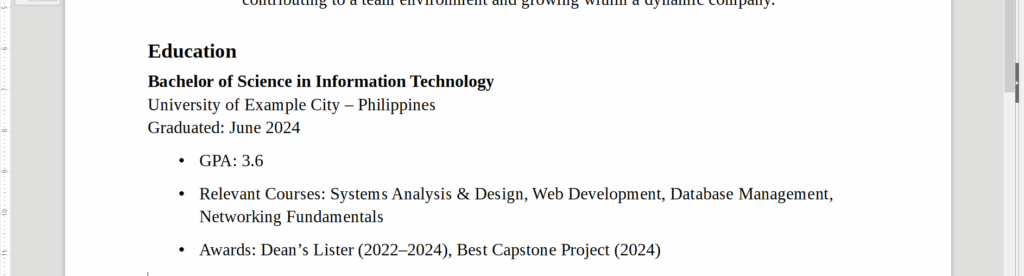
Since you’re likely starting your career, your education is one of your biggest selling points. List your degree, the name of your school, and your graduation year. If you took courses relevant to the job or earned any honors or awards, include those too. If your GPA is 3.5 or higher, it’s worth mentioning as it reflects your dedication and academic success.
Resume Hacks for Graduates: Highlight Internships & Volunteer Work
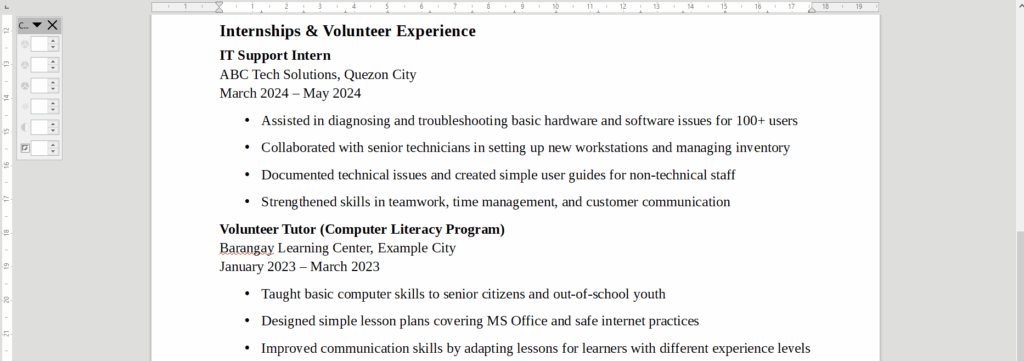
Treat any internships, on-the-job training, or volunteer experiences like real job roles. Use bullet points to describe what you did and what you accomplished. Focus especially on skills that can be applied in many workplaces, such as communication, teamwork, and managing your time effectively. These experiences show employers you’ve already developed important professional habits.
Resume Hacks for Graduates: Show Your Skills and Tools
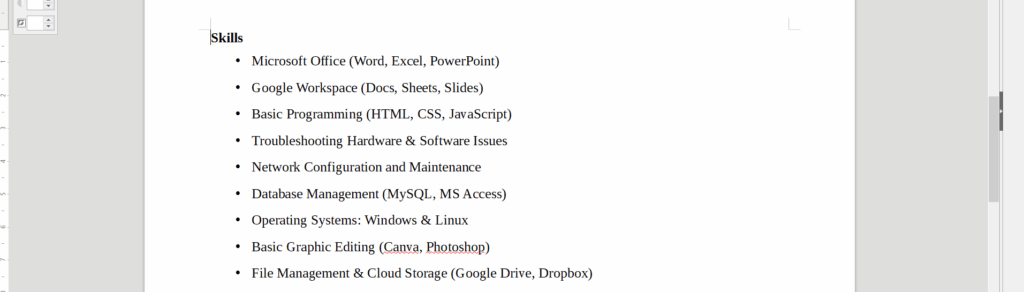
Divide your skills into two categories: hard and soft skills. Hard skills might include things like proficiency in Microsoft Office, Google Workspace, programming languages, or graphic design software. Soft skills could be communication, leadership, adaptability, or problem-solving. Try to match your skills to what the job posting asks for, so employers can quickly see you’re a good fit.
Resume Hacks for Graduates: Feature Relevant Projects
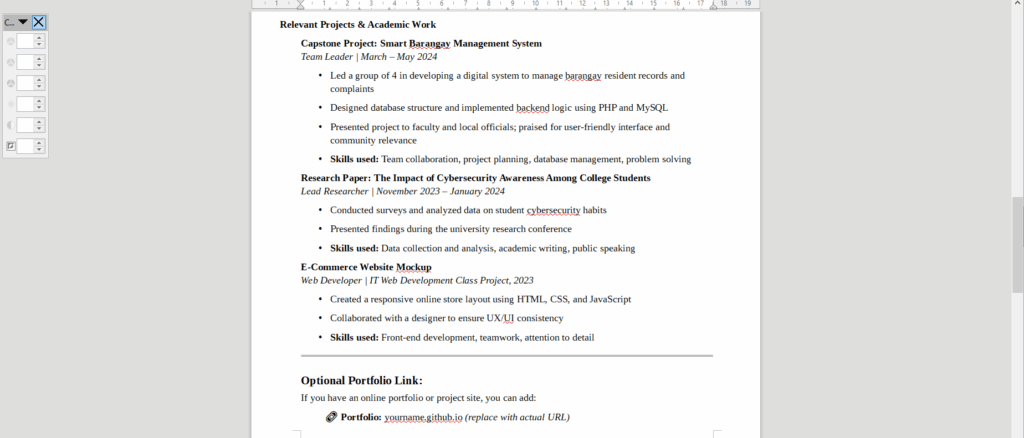
Listing academic projects is a key resume hack for graduates without job experience. If you’ve worked on group projects, research assignments, or case studies during your studies, list the ones that relate to the job. Briefly explain your role, what the project achieved, and which skills you used. If you have an online portfolio or a website showcasing your work, include a link so employers can explore your work in more detail.
Resume Hacks for Graduates: Use Keywords from Job Postings
One of the most overlooked resume hacks for graduates is matching the job ad’s language to pass applicant tracking systems (ATS). Each job application is unique, so customize your resume by incorporating keywords and phrases from the job description. This not only helps your resume catch the eye of hiring managers but also improves your chances of passing through applicant tracking systems (ATS) that many companies use to filter resumes.
Resume Hacks for Graduates: Keep It Clean and Easy to Read
Choose a simple, professional layout that makes your resume easy to scan. Stick to one page, especially if you’re just starting out. Use bullet points to organize information clearly, highlight job titles in bold, and maintain consistent font styles and sizes throughout. Avoid clutter or overly decorative fonts that can distract from your content.
There are many resume templates available online—Canva is a great example of a platform where you can find plenty of options. However, I strongly recommend choosing a clean and simple template. A straightforward design makes your resume easier to read and helps ensure that the focus stays on your skills and experience, rather than on distracting graphics or overly complicated layouts. Keeping it professional and clear will make a much better impression on potential employers
Avoid Common Mistakes
Proofread your resume carefully to eliminate typos and grammatical errors—these can make a poor impression. Be honest about your skills and experiences; never exaggerate or lie. Also, leave out personal details like your age, religion, or a photo unless the employer specifically requests them, as these are usually not necessary and can lead to bias.
End with a Simple But Strong Statement
Close your resume with a brief statement that shows you’re eager to learn and grow. Mention your openness to training or further development, and if relevant, your willingness to relocate or adjust your schedule. This leaves employers with a positive impression of your attitude and flexibility.
Final Statement
I am eager to apply my skills in a professional environment, learn from experienced mentors, and contribute to a team’s success. I am open to training opportunities and willing to adapt to new challenges, including relocation or flexible work schedules, to support the company’s goals.
Tips for Fresh Graduates Beyond the Résumé
1. Build a Strong LinkedIn Profile
Start by adding a clear, professional photo—this helps create a good first impression. Write a headline that sums up who you are and what you’re looking for, like “IT Graduate | Eager to Learn | Seeking Entry-Level Role.” Make sure to list your education, skills, and any projects or internships you’ve done. Don’t forget to connect with classmates, teachers, and professionals in your field to start building your network.
2. Practice for Interviews Early
Prepare answers to common interview questions like “Tell me about yourself,” “What are your strengths and weaknesses?” and “Why should we hire you?” Try practicing with a friend, recording yourself, or using online mock interview tools. Also, think of good questions to ask the interviewer—it shows you’re interested and confident.
3. Be Active on Job Platforms
Create profiles on job sites like LinkedIn, JobStreet, Indeed, and Kalibrr. Turn on job alerts so you don’t miss new opportunities. Apply to several jobs instead of waiting for the “perfect” one. Also, don’t overlook entry-level roles with different titles like “trainee,” “junior,” or “assistant” – they can be great starting points.
4. Customize Every Application
Always tailor your resume and cover letter for each job. Mention the company’s name and explain how your goals align with theirs. Use keywords from the job posting—this helps your application get noticed by both hiring managers and automated systems.
5. Start Networking Early
Join Facebook groups or Discord servers related to your field. Attend job fairs, workshops, or seminars, whether virtual or in person. Don’t hesitate to reach out to former professors, classmates, or internship supervisors for advice or referrals—they can be valuable contacts.
6. Research the Skills Your Dream Job Needs – Then Learn Them
Look at job listings for the role you want and note the common skills, tools, or certifications they require. Use free resources like YouTube tutorials or websites like Udemy, Coursera, LinkedIn Learning, or Khan Academy to study these skills. Learning ahead of time gives you a leg up even before you land your first job.
7. Stay Busy While Job Hunting
Use this time to take short courses, volunteer, freelance, or work on passion projects. If you’re in a creative or tech field, build a portfolio or GitHub account to showcase your work. Staying active helps you grow and shows employers you’re motivated.
8. Be Open to Entry-Level or Contract Work
Your first job doesn’t have to be perfect. The goal is to gain experience, learn, and grow. Many people start as interns, customer service reps, or data entry clerks and then move up from there. Getting your foot in the door is what counts most.
9. Prepare a Professional Email and Voicemail
Use a simple, professional email address—something like [email protected] works best. Also, set up a polite and clear voicemail message in case recruiters call you and you can’t answer.
10. Track Your Applications
Keep a simple spreadsheet or use apps like Notion to track the jobs you’ve applied for, deadlines, follow-ups, and the status of each application—whether you’ve been interviewed, are waiting to hear back, or were rejected.
11. Stay Confident and Patient
Rejections are part of the process—don’t take them personally. Keep learning, keep applying, and be open to feedback. With confidence and consistency, you’ll improve your chances and eventually find the right opportunity.
One Last Thing
I know it’s not easy figuring out what to do after graduation — the pressure, the confusion, the “what now?” moments. But let me remind you: you don’t have to have it all figured out right away. What matters is that you’re trying, learning, and showing up — that already puts you ahead of many.
Start with the basics: fix your resume, research the job you want, and slowly build the skills you need. Watch free tutorials, apply even if you’re not 100% confident, and don’t be afraid of small beginnings. That first job doesn’t define your future — it just gets your foot in the door.
And hey, don’t compare your timeline with others. Your journey is yours. Just keep going, keep learning, and trust that your time will come.
Great advice, Thank you.